InfoGAN: Interpretable Representation Learning by Information Maximizing Generative Adversarial Nets
This paper describes InfoGAN, an information-theoretic extension to the GAN that is able to learn disentangled representations in a completely unsupervised manner. InfoGAN maximizes the mutual information between a small subset of the latent variables and the observations.
Mutual Information for Inducing Latent Codes
The minimax game defined by GAN is given by
This GAN formulation imposes no restrictions on the manner in which the generator may use this noise \(z\), which may lead to a highly entangled representation.
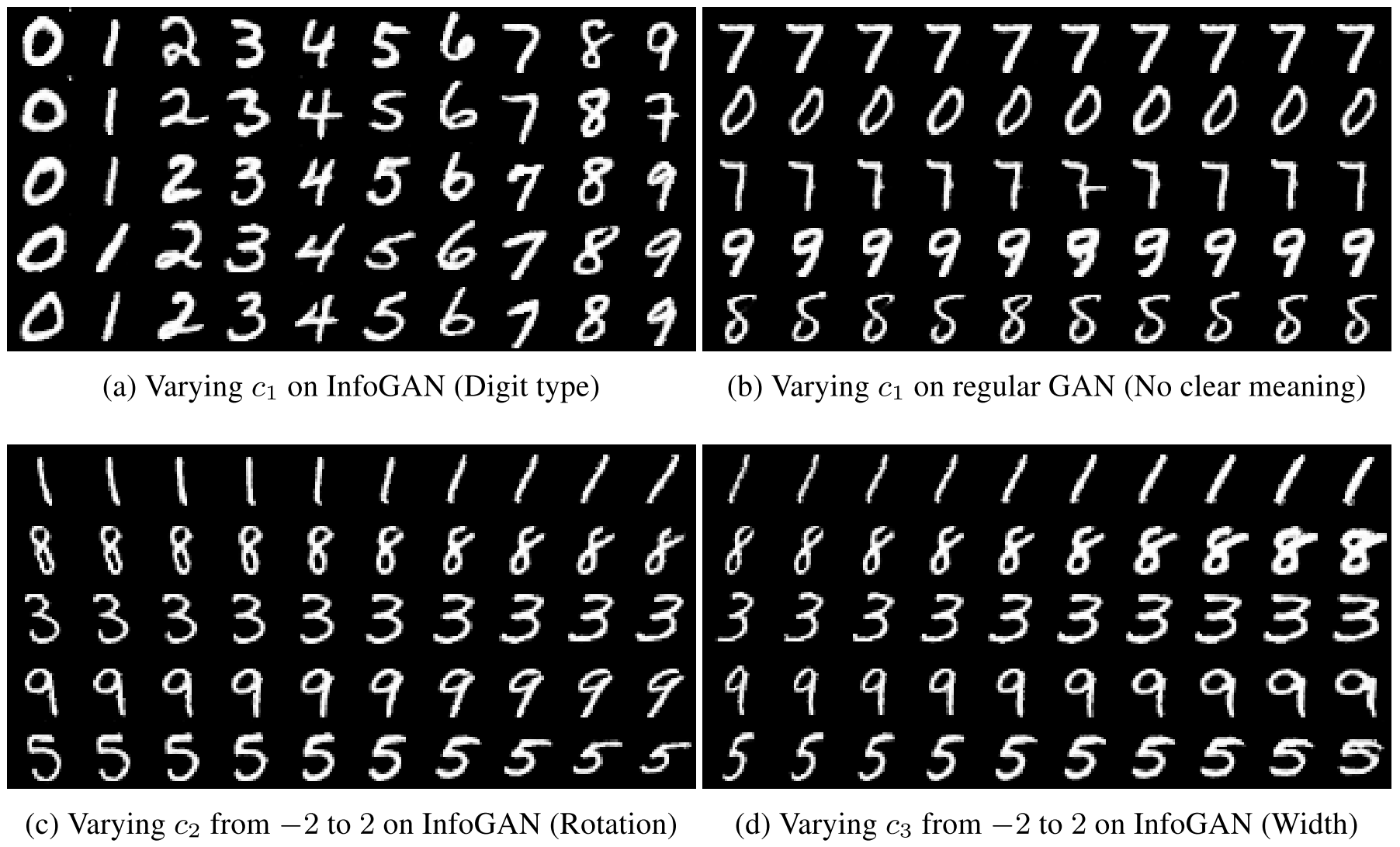
The authors propose to decompose the input noise vector into two parts: (i) \(z\), which is treated as source of incompressible noise; (ii) \(c\), which we will call the latent code and will target the salient structured semantic features of the data distribution.
Now the form of the generator becomes \(G(z, c)\). However, standard GAN may ignore the additional latent code \(c\) by finding a solution satisfying \(P_G(x \mid c) = P_G(x)\). To cope with this problem of trivial codes, the authors propose an information-theoretic regularization: there should be high mutual information between latent codes \(c\) and generator distribution \(G(z, c)\).
Given any \(x \sim P_G(x)\), we want \(P_G(c \mid x)\) to have a small entropy. The information in the latent code \(c\) should not be lost in the generation process. The authors propose to solve the following information-regularized minimax game:
Note
Mutual Information
In information theory, mutual information between two random variables \(X\) and \(Y\), \(I(X, Y)\), measure the “amount of information” learned from knowledge of \(Y\) about \(X\). The mutal information can be expressed as the difference between two entropy terms:
This definition has an intuitive interpretation: \(I(X; Y)\) is the reduction of uncertainty in \(X\) when \(Y\) is observed.
Variational Mutual Information Maximization
The mutual information term \(I(c; G(z, c))\) is hard to maximize directly as it requires access to the posterior \(P(c \mid x)\). The authors define an auxiliary distribution \(Q(c \mid x)\) to approximate \(P(c \mid x)\) and obtain a lower bound of \(I(c; G(z, c))\):
This technique of lower bounding mutual information is known as Variational Information Maximization.
Lemma 5.1. For random variables \(X\), \(Y\) and function \(f(x, y)\) under suitable regularity conditions:
With Lemma 5.1, we can define a variational lower bound \(L_I(G, Q)\) of the mutual information:
The authors note that \(L_I(G, Q)\) is easy to approximate with Monte Carlo simulation. In particular, \(L_I\) can be maximized w.r.t. \(Q\) directly and w.r.t. \(G\) via the reparameterization trick.
Hence, InfoGAN is defined as the following minimax game:
Implementation
In practice, the authors parameterize the auxiliary distribution \(Q\) as a nueral network. \(Q\) and \(D\) share all convolutional layers and there is one final fully connected layer to output parameters for the conditional distribution \(Q(c \mid x)\).
For categorical latent code \(c_i\), a softmax nonlinearity is used to represent \(Q(c_i \mid x)\). For continuous latent code \(c_i\), treating \(Q(c_i \mid x)\) as a factored Gaussian is sufficient.
Experiments