CPTR: Full Transformer Network for Image Captioning
In this paper, the authors consider the image captioning task from a new sequence-to-sequence prediction perspective and propose CaPtion TransformeR (CPTR). Compared to the “CNN + Transformer” design paradigm, CPTR can model global context at every encoder layer from the beginnning and is totally convolution-free.
Extensive experiments demonstrate the effectiveness of the proposed model and CPTR surpass the conventional “CNN + Transformer” methods on the MSCOCO dataset.
Framework
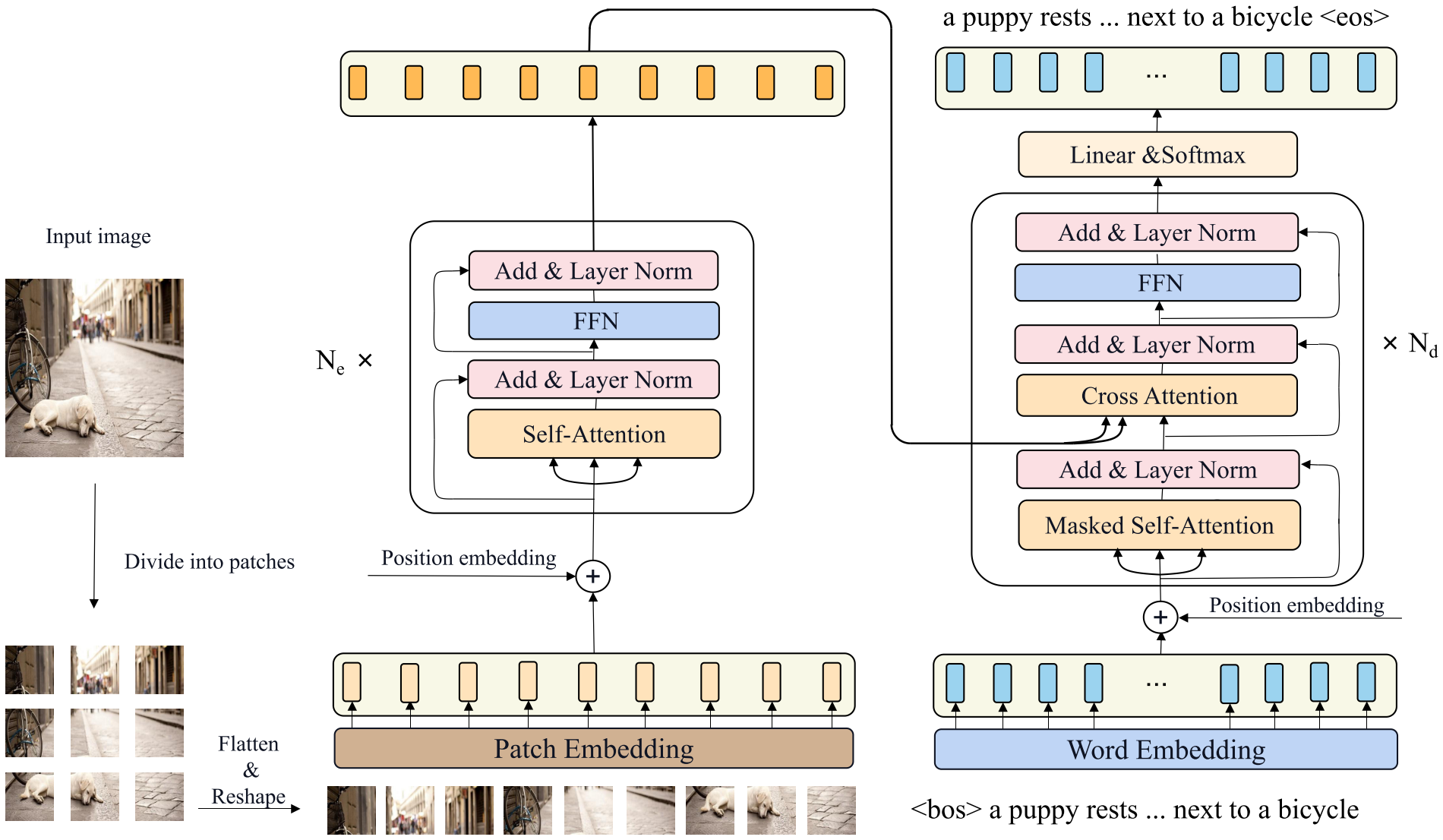
Instead of using a pretrained CNN or Faster R-CNN model to extract spatial features or bottom-up features, the authors sequentialize the input image and treat image cpationing as a sequence-to-sequence prediction task.
The input image is first reshaped into a fixed resolution \(X \in \mathbb{R}^{H \times W \times 3}\), and then divided into \(N\) patches, where \(N = \frac{H}{P} \times \frac{W}{P}\). After that the authors flatten each patch and reshape them into a 1D patch sequence \(X_p \in \mathbb{R}^{N \times (P^2 \cdot 3)}\). A linear embedding layer is then used to map the flattened patch sequence to laten space and a learnable 1D position embedding is added to the patch features.
The encoder of CPTR consists of \(N_e\) stacked identical layers, each of which consists a multi-head self-attention (MHA) with \(H\) heads followed by a positional feed-forward network.
The decoder of CPTR uses sinusoid positional embedding to the word embedding features and includes \(N_d\) stacked identical layers which consists of a masked multi-head self-attention layer followed by a multi-head cross attention and a positional feed-forward sublayer.
Experiments
CPTR is trained in an end-to-end fasion with the encoder initialized by the pre-trained ViT model.
input image resolution: \(384 \times 384\)
path size: \(16 \times 16\)
feature dimension: \(768\)
attention head number: \(12\)
encoder layers: \(12\)
decoder layers: \(4\)
Ablation Study
